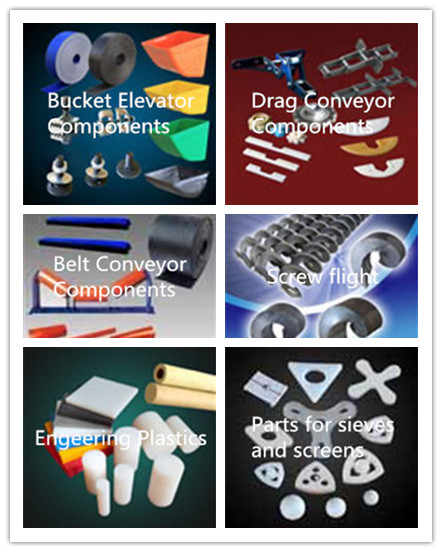

Nylon, also known as polyamide (PA), is one of the most widely used engineering plastics. Due to its good mechanical strength, wear resistance, low friction coefficient, and dimensional stability, nylon is widely used for industrial components, wear parts, rollers, gears, and other applications.
Nylon was developed by the outstanding American scientist Carothers (Carothers) and a scientific research team under his leadership. It was the first synthetic fibre to appear in the world.
The emergence of nylon has given a brand new look to textiles. Its synthesis is a major breakthrough in the synthetic fibre industry and a very important milestone in polymer chemistry.
The main component of nylon is polyamide, and its amide group -NHCO- has polarity, which makes nylon have double-sided water absorption and dehydration. Nylon without water absorption is more brittle and easier to break, and its physical properties will only appear after water absorption. The finished products will become brittle and break when used in a long-term dry and low-temperature environment, and will shorten the service life of nylon. Therefore, it is necessary to know whether the nylon is molded and whether it has been boiled in oil and is isolated from the environment.
Analysis of the reason why nylon parts are boiled in water: The nylon we commonly use is a crystalline thermoplastic material. The nylon material is easy to absorb water and contains a hydrophilic group (acylamino). For crystalline polymers, during the injection molding process, the rapid cooling makes the material unable to crystallise and shape naturally, resulting in strong internal stress inside the material. Nylon materials that have not undergone “tempering” treatment have their insides after being shaped; macromolecules will still tend to move in natural orientation and crystallisation, which will further increase the internal stress of the material. Therefore, the nylon parts that have not undergone the boiling process are very brittle and are easy to collapse or break when subjected to external forces. So, what if the molded nylon macromolecules are allowed to naturally orient and crystallise to eliminate internal stress as much as possible? That is what we are talking about. The boiling process is actually similar to our metal “tempering” process. That is to let the nylon parts soak in a certain water temperature, so that the macromolecules inside tend to naturally orient as much as possible and achieve the balance of internal crystallisation and decrystallization, thereby eliminating its internal stress. The manifestation is that the toughness of nylon parts is greatly enhanced, and the brittleness is basically eliminated. So why boil it in water? That is because nylon contains a hydrophilic group- the amide group- which causes nylon to easily absorb water, but after nylon absorbs a certain amount of water, it helps the orientation and crystal movement of its internal macromolecules. The best temperature and time for boiling nylon parts: 90-100°C, 2-3 hours. Below 90 degrees, the effect is not good; more than 3 hours, there will be no better results. In terms of cost performance, the above process conditions are the best.
Nylon Advantages
Nylon offers several advantages compared with ordinary plastics:
- Good wear resistance – suitable for moving parts and components exposed to friction.
- High mechanical strength – provides reliable performance under load.
- Low friction coefficient – helps reduce friction and improve operating efficiency.
- Good impact resistance – suitable for applications involving shock or repeated movement.
- Light weight – provides a practical alternative to some metal components.
One important characteristic of nylon is its moisture absorption. Compared with some other engineering plastics, nylon absorbs more moisture, which may slightly affect dimensional stability. Therefore, the material selection should consider the working environment and required precision.
Nylon is a versatile engineering plastic with excellent wear resistance, strength, and self-lubricating properties. By selecting the correct nylon grade and design, it can provide reliable performance in many industrial applications.
YT Conveyor supplies customized engineering plastic products and conveyor-related components according to customer drawings and application requirements.
Yutung Conveyor parts manufacturer
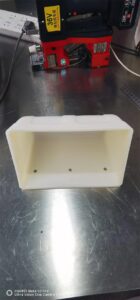
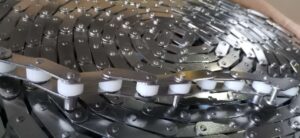
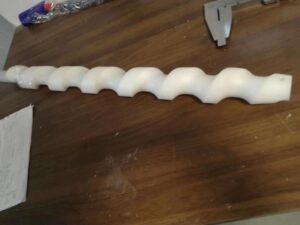
Nylon is widely used in engineering applications where wear resistance, strength, and low friction are required. At YT Conveyor, nylon is used for different conveyor components and engineering plastic products, including nylon rollers, nylon wheels, and other customized parts.
Explore our engineering plastic products for nylon, UHMWPE, HDPE, PTFE, POM, and other industrial plastic materials.