

What Is SR Small Rotary Paddle Level Switch for Silo and Bin (Small Rotary Paddle Bin Level Indicator)?
The small rotary paddle bin level indicator is designed for level detection in small silos, bins and hoppers.
Its compact size makes it suitable for installations where space is limited, while still providing reliable monitoring of material levels.
Working Principle of Small Rotary Paddle Level Indicator
The device uses an electric motor to drive a paddle blade to rotate continuously.
When bulk material reaches the paddle, the rotation is blocked due to material resistance. This triggers the internal control mechanism and outputs a signal to indicate material presence.
When the material level drops, the paddle is released and resumes rotation under spring force, allowing continuous monitoring.
Key Features of Small Rotary Paddle Level Indicator
- Compact structure, ideal for small silos and limited installation space
- Zinc alloy housing, strong and durable
- Equipped with high-quality motor for stable performance
- Suitable for detecting different materials with various paddle options
- Reliable level detection with low power consumption
- Easy to install and operate
Technical Specifications of Small Rotary Paddle Level Indicator
The following technical data is for reference:
- Voltage: 220VAC, 110VAC, 24VAC, 24VDC
- Contact Capacity: 250VAC / 5A(Negative Load) (SPDT)(Single Pole Double Throw)
- Power: 1.5W
- Torque: approx. 4.9 N·cm
- Paddle Speed: 1 RPM
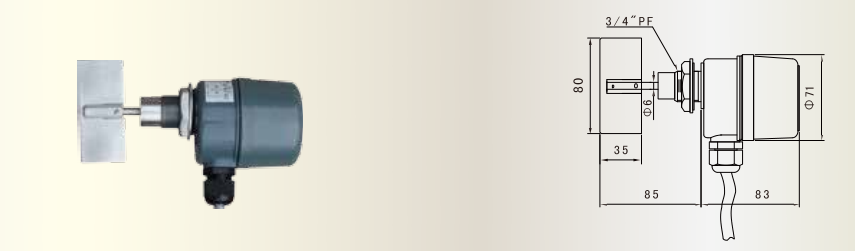
- Paddle Size: 80 × 35 mm
- Paddle Types: straight, bent and spring type
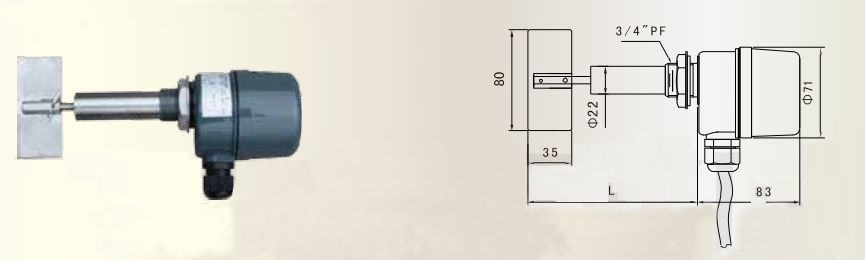
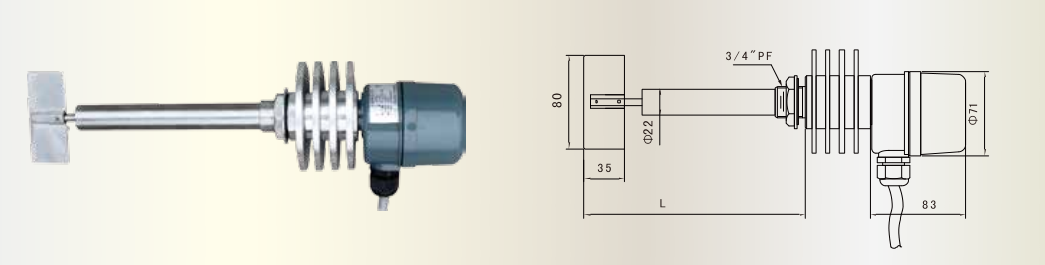
- Insert Length: standard L = 85 mm, can customize the length.
- Working Temperature:
- Standard: -30°C to 80°C
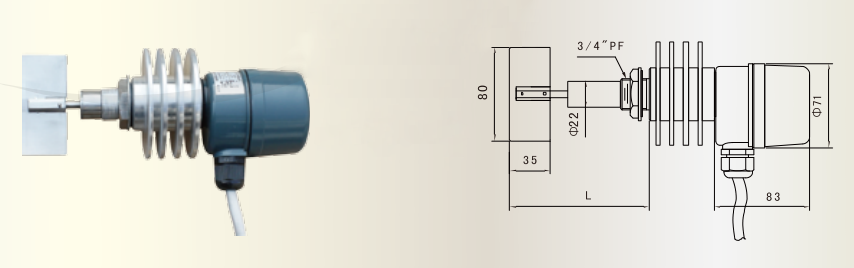
- High-temperature type: up to 200°C
- Protection cable: 5-core, 500 mm length
SR Small Rotary Paddle Level Switch – Model Variants
SR-80 Small Rotary Paddle Level Switch
Standard Type
SR-80L Small Rotary Paddle Level Switch
The Axis Protection Tube Longer Type
SR-80T Small Rotary Paddle Level Switch
High-Temperature Type
SR-80LT Small Rotary Paddle Level Switch
High-Temperature Longer Type
Model Selection Guide for SR Small Rotary Paddle Level Switch
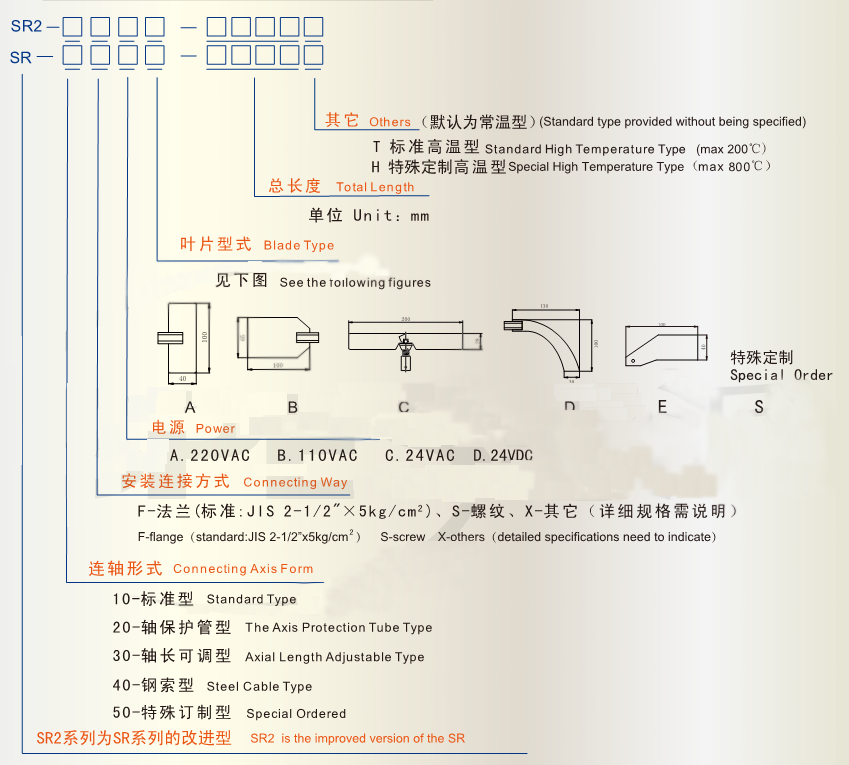
For Example SR2-10SAA-0800
Means: Standard Screw Type, 220VAC, A Type 100x40mm Rotary Paddle, total length 800mm.
Applications of Small Rotary Paddle Level Indicator
This compact level indicator is widely used for:
- Small silos and storage bins
- Hoppers and feeding systems
- Powder and granular materials
- Light to medium bulk material detection
It is an ideal solution for applications requiring space-saving installation and reliable level monitoring.
Small rotary paddle level indicators can be integrated into grain storage and bulk material handling systems together with our grain conveyor components, including elevator buckets, conveyor belts, cleaning parts, vibration motors, and other compatible accessories.
Installation Guidelines for Silo Level Switch
To ensure proper operation and long service life, please follow the installation guidelines below:
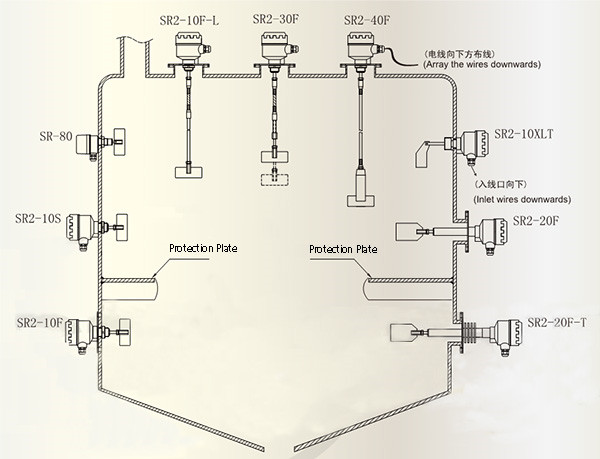
1. Power Supply Check
Please confirm the correct power supply before installation to avoid damage to the motor.
2. Installation Position
Install the level switch away from the material inlet to prevent direct impact from falling materials.
3. Cable Direction and Sealing
- For horizontal installation, ensure the cable entry is facing downward
- For vertical installation, also ensure the cable is directed downward (refer to the diagram)
Secure the cable gland and junction box cover tightly to prevent rainwater, dust or foreign matter from entering the unit.
4. Installation Angle (Horizontal Mounting)
For horizontal installation, it is recommended to mount the level switch with a downward inclination of 15–20°.
This helps reduce material accumulation around the paddle.
5. Protection for Lower Installation Position
When the level switch is installed in a lower position, a protective plate is recommended to prevent damage from material impact.
A semi-circular protective tube can be used:
- At least 50 mm longer than the level switch
- Installed approximately 250 mm above the switch
- Fixed or welded in position for effective protection
Maintenance and Troubleshooting
Proper maintenance and timely troubleshooting can ensure stable operation and extend the service life of the level switch.
Routine Maintenance
- Regularly check the paddle rotation condition to ensure it operates smoothly
- Inspect the sealing parts and cable entry to prevent dust or moisture ingress
- Clean any material build-up around the paddle to avoid false signals
- Periodically check the electrical connections for safety and reliability
Common Issues and Solutions
1. Paddle does not rotate
- Check power supply and wiring connections
- Inspect whether the motor is damaged
- Ensure no material blockage is preventing rotation
2. False level signal (incorrect detection)
- Check if material has accumulated around the paddle
- Verify whether the paddle type is suitable for the material density
- Adjust installation position or angle if necessary
3. No signal output
- Check electrical contact and control system
- Verify switch contact capacity and connection status
- Inspect internal components for damage
4. Frequent overload or motor protection activation
- Check if material density is too high
- Ensure proper paddle selection
- Inspect for excessive material impact
Maintenance Recommendation
For long-term stable operation, it is recommended to perform regular inspection and cleaning, especially in environments with high dust, moisture or sticky materials.
Available Types of Silo Level Switches and Sensors
We offer a wide range of level detection solutions for silo and bin applications, including:
- Rotary Paddle Level Switch
- Small Rotary Paddle Level Switch
- Capacitance Level Switch
- RF Admittance Level Sensor
- Radar Level Sensor and Ultrasonic Level Sensor
- Weighing Level Sensor
- Pneumatic Hammer and Vibrator
Related Products for Silo & Bin Systems
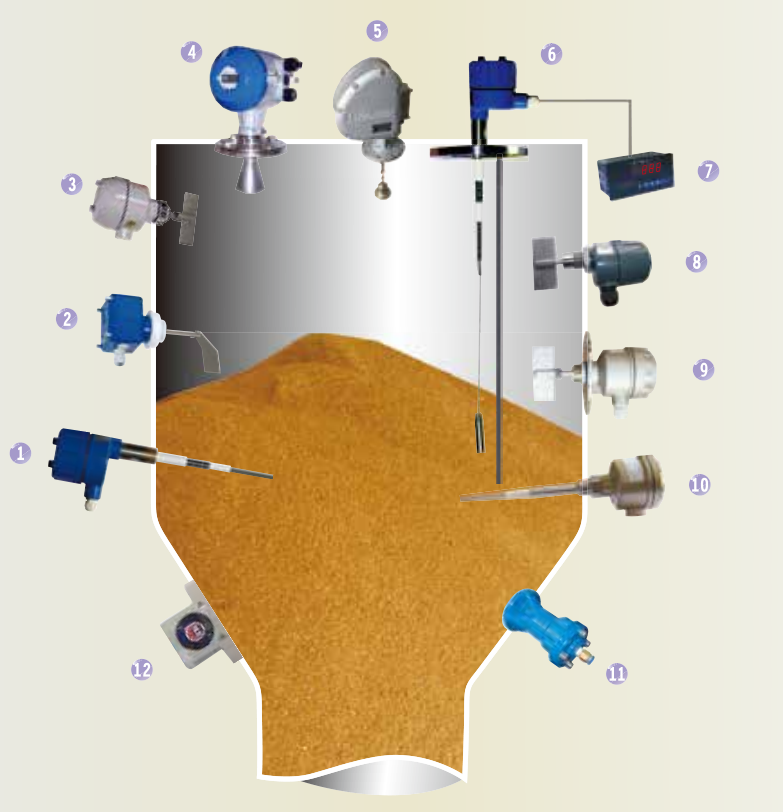
- RF Admittance Sensor
- Rotary Paddle Level Switch
- Rotary Paddle Level Switch
- Radar Sensor
- Sensing Weight Level Sensor
- RF Admittance Level Sensor
- Digital Displayer
- Small Rotary Paddle Level Switch
- Rotary Paddle Level Switch
- Capacitance Sensor Level Switch
- Pneumatic Hammer
- Pneumatic Vibrator
FAQ – Bin Level Indicator
What is a bin level indicator?
A bin level indicator is a device used to detect material levels inside silos, bins, and hoppers. It helps monitor whether bulk material has reached a preset level within the storage container.
What applications are suitable for a bin level indicator?
Bin level indicators are commonly used in small silos, storage bins, hoppers, feeding systems, and bulk material handling equipment for powders, granules, and light to medium bulk materials.
How does a rotary paddle bin level indicator work?
A rotary paddle bin level indicator uses an electric motor to rotate a paddle continuously. When material reaches the paddle, the rotation is blocked by material resistance, which triggers an internal control signal. When the material level drops, the paddle resumes rotation for continuous monitoring.
What are the main features of a bin level indicator?
Bin level indicators provide reliable level detection, low power consumption, stable operation, compact structure, and easy installation. Different paddle types are available to suit various material conditions.
What materials and housing are used for the bin level indicator?
The bin level indicator uses a durable zinc alloy housing designed for long-term operation in industrial environments.
What paddle types are available for bin level indicators?
Available paddle types include straight, bent, and spring-type paddles. Different paddle designs are selected depending on the bulk material being monitored.
Where should a bin level indicator be installed?
A bin level indicator is typically installed on the side or top of a silo, hopper, or bin. It should be positioned away from the material inlet to reduce direct impact from falling material.
Related Products for Silo Level Detection and Material Flow
You may also be interested in:


