

Welded Steel Elevator Bucket Overview
Welded customized steel elevator buckets are designed for applications where standard stamped buckets cannot meet specific requirements. They provide greater flexibility in structure, size, and thickness for tailored solutions.
Manufacturing Method
Unlike stamped buckets formed as a single unit, welded buckets are fabricated by assembling multiple steel plates through welding.
This allows for:
- Customized dimensions and shapes
- Adjustable wall thickness for different load conditions
- Reinforced structures for heavy-duty applications
Design Advantages
Welded steel buckets offer several advantages:
- Higher adaptability for non-standard systems
- Suitable for heavy, abrasive, or large particle materials
- Flexible design for special conveying conditions
- Easy to modify based on drawings or samples
Applications
Common applications include:
- Mining and aggregates
- Cement and construction materials
- Chemical and fertilizer industries
- Bulk industrial material handling
When to Choose Welded Buckets
Welded buckets are recommended when:
- Standard molds are not suitable
- Custom sizes or shapes are required
- The application involves heavy-duty or high-impact materials
- Small batch or project-based production is needed
For complete matching with custom or heavy-duty elevator systems, welded steel buckets can be combined with our bucket elevator components, including elevator belts, bolts, pulleys, belt fasteners, and other compatible accessories.
Comparison with Stamped Buckets
Stamped buckets
- Fixed size based on mold
- Seamless one-piece structure
- Suitable for standard applications
Welded buckets
- Fully customizable design
- Flexible thickness and structure
- Suitable for heavy-duty and special applications
Common Welded Bucket Structures
We customize steel elevator buckets based on specific project requirements, offering a wide range of materials, dimensions, and structural designs.
Below are three commonly used welded bucket structures we recommend, each designed to suit different applications and operating conditions.
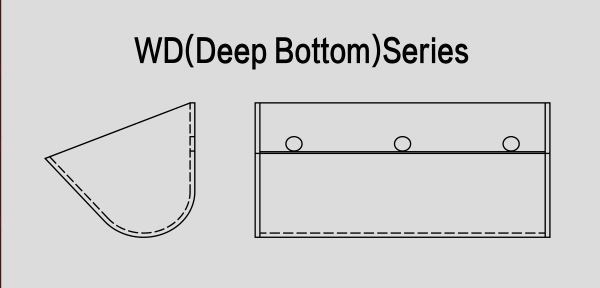
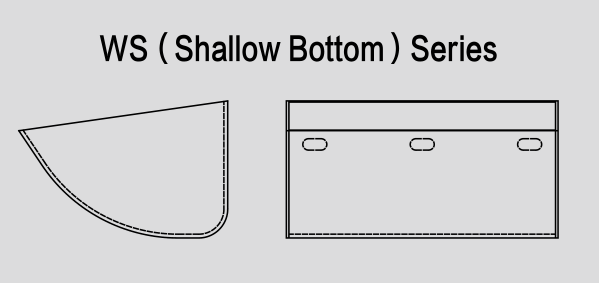
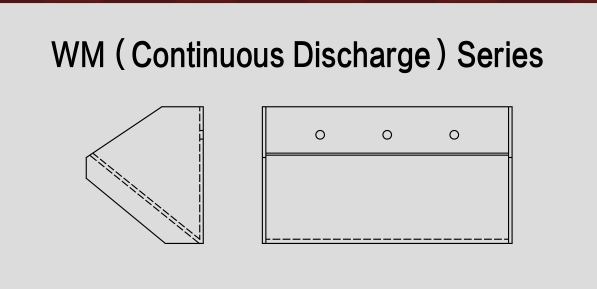
Custom buckets are available based on drawings, samples, or project requirements.
Stamped vs Welded Steel Buckets: Which One Is Right for Your Application?
Steel elevator buckets are typically manufactured using either stamping or welding processes. Each method has its own advantages depending on your application, material, and production requirements.
| Feature | Stamped Steel Buckets (DQ / DS Type) | Welded Steel Buckets |
|---|---|---|
| Manufacturing Process | One-piece deep drawing (stamping) | Fabricated by welding multiple plates |
| Structure | Seamless, one-unit construction | Multi-part assembly with weld joints |
| Strength | High integrity and uniform strength | Strong but depends on welding quality |
| Wear Resistance | Excellent due to smooth surface | Good, but weld areas may wear faster |
| Capacity Design | Standardized sizes (DQ shallow / DS deep) | Flexible, fully customizable shapes |
| Customization | Limited | Highly customizable (size, thickness, structure) |
| Production Efficiency | High, suitable for mass production | Lower, more labor-intensive |
| Cost | Lower for standard models | Higher due to customization and labor |
| Application | Grain, feed, agriculture, general bulk handling | Heavy-duty, abrasive materials, special layouts |
| Temperature Resistance | Suitable for high-temperature environments | Also suitable, depends on material selection |
Stamped buckets are ideal for standard, high-volume applications, while welded buckets are recommended for heavy-duty or customized conveying systems.
FAQ – Welded Customized Elevator Steel Bucket
What is a welded customized elevator steel bucket?
A welded customized elevator steel bucket is a fabricated steel bucket designed for bucket elevator systems where standard stamped buckets cannot meet specific size, structure, or performance requirements.
How is a welded steel bucket different from a stamped steel bucket?
Welded steel buckets are manufactured by joining multiple steel plates through welding, while stamped buckets are formed as a seamless one-piece design. Welded buckets offer greater flexibility for custom dimensions and heavy-duty applications.
What are the advantages of welded customized elevator buckets?
Welded customized elevator buckets provide flexible sizing, adjustable wall thickness, reinforced construction, and the ability to handle demanding conveying conditions where standard buckets may not be suitable.
What materials are available for welded steel elevator buckets?
Welded steel elevator buckets are commonly manufactured in carbon steel, abrasion-resistant steel, and stainless steel depending on wear resistance, corrosion resistance, and operating conditions.
What industries use welded customized elevator steel buckets?
These buckets are widely used in mining, cement, aggregates, fertilizer production, chemical processing, and heavy industrial bulk material handling.
When should I choose a welded elevator bucket instead of a standard bucket?
Welded elevator buckets are recommended when custom dimensions, special shapes, heavy-duty materials, or project-specific conveying requirements cannot be achieved with standard molded or stamped bucket designs.
Can welded steel buckets handle abrasive or heavy materials?
Yes, welded steel buckets are commonly selected for abrasive, high-impact, or large-particle materials because they can be reinforced and manufactured with thicker steel plates for improved durability.
Can welded customized elevator steel buckets be made to customer drawings?
Yes, welded customized elevator buckets can be manufactured according to drawings, samples, dimensions, and project requirements to ensure compatibility with existing bucket elevator systems.
👉Need a custom-designed steel bucket for your system?
Send us your drawings or requirements — we’ll provide a tailored solution.


